Drying to a measured goal
Structural Drying in La Mesa, CA
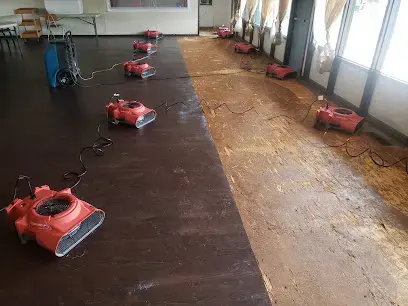
Surface-dry is not dry. The drying team runs air movers and LGR dehumidifiers sized to each room and keeps them running until the framing, drywall and slab read within a few points of a dry reference.
(888) 450-9281Water still spreading? Call La Mesa now.- IICRC S500 drying standard
- LGR dehumidifiers
- Daily moisture readings
First steps
What to do first while structural drying is underway in La Mesa
- Keep equipment running and plugged in, even overnight.
- Keep windows and exterior doors closed unless the drying team says otherwise.
- Leave baseboards and access holes open until readings are done.
- Keep the thermostat in the range the drying team sets.
- Call if a breaker trips or a unit stops running.
The trade facts that apply
- Class 1 through 4 sets how much equipment a room needs.
- LGR dehumidifiers pull water from air at lower humidity than standard units.
- Desiccant dehumidifiers handle dense Class 4 materials like hardwood and concrete.
- The drying goal is set against a dry reference material in the same building.
Call before the water reaches the subfloor: (888) 450-9281
How the work is handled
How structural drying is handled in La Mesa, CA
- 1
Map and classify
The tech who does the walkthrough maps moisture and sets the class of loss, which decides the equipment count.
- 2
Set equipment
The drying team places air movers along wet walls and floors and sizes dehumidifiers to the room volume.
- 3
Read every day
Daily moisture and psychrometric readings show whether the air and materials are drying on pace.
- 4
Adjust and verify
Equipment moves as areas dry and comes out when every reading meets the drying goal.
Typical cost
What does structural drying cost in La Mesa, CA?
In La Mesa, CA, structural drying typically runs $1,000 to $6,000, depending on the class of loss, the number of rooms, dense materials like hardwood or concrete, and how quickly drying started after the water stopped.
Class 1 or 2 room
$1,000 to $2,200
- Air movers and LGR
- Three to four days
- Daily readings
Several rooms
$2,200 to $4,000
- More equipment
- Cavity drying
- Slab edges
Class 4 materials
$4,000 to $7,000+
- Hardwood or concrete
- Desiccant units
- Extended drying
These are typical ranges, not a quote. Try the water damage cost calculator for a planning number.
What structural drying means
After the extraction crew removes standing water, the building still holds a lot of it inside drywall, framing, subfloors and concrete. Structural drying is the process of pulling that moisture out on purpose, with equipment sized to the loss, and proving it worked with readings. The IICRC S500 standard is the industry reference for how it is done.
In La Mesa the dry climate helps for most of the year, but a slab or a hardwood floor still gives up water slowly, and winter storms raise indoor humidity just when drying matters most.
The equipment and why it is placed where it is
Air movers blow across wet surfaces to speed evaporation. Dehumidifiers then capture that moisture from the air so it does not settle back into the materials. LGR units work at lower humidity than standard units, and desiccant units handle dense materials like hardwood, plaster and concrete.
- Class 1: small area, low-porosity materials, light equipment.
- Class 2 and 3: carpet, pad and walls wet, more air movement.
- Class 4: hardwood, plaster, concrete, often desiccant drying.
Equipment leaves on readings, not a schedule
A contained Class 1 loss usually dries in three to five days; hardwood and slabs take longer. The drying team compares daily readings with a dry reference material in an unaffected part of the same building and pulls equipment only when wet materials sit within 2 to 4 points of it. The EPA indoor air quality page explains why humidity control matters, and the EPA moisture page covers the 24 to 48 hour growth window. Try the drying time estimator for a planning range.
Service area
Structural Drying across La Mesa and nearby
The La Mesa restoration crew handles structural drying in every La Mesa neighborhood and the hills around it.
The drying team covers every La Mesa neighborhood and the hills around it, from La Mesa Village and Grossmont to Mount Helix and Lake Murray.
Coverage includes La Mesa Village, Grossmont, Mount Nebo, Windsor Hills, Mount Helix, Casa de Oro, Fletcher Hills, Spring Valley, Rolando, San Diego College Area, Del Cerro and the rest of the area, with ZIP codes 91941, 91942, 91943, 91944.
See every area and ZIP coveredRelated
Related water damage services in La Mesa
Questions
Structural Drying questions in La Mesa, CA
What is the IICRC S500 standard?
IICRC S500 is the industry standard for professional water damage restoration. It covers how to classify water and losses, how to set up drying equipment and how to confirm that materials are dry before equipment is removed.
Why are the air movers so loud and why must they stay on?
Air movers push a lot of air across wet surfaces to speed evaporation. Turning them off at night stalls the drying and can add days to the job.
How does the team know the house is dry?
The drying team takes daily moisture readings of wet materials and compares them with a dry reference material of the same type in an unaffected area. Drying is done when the readings match within a few points.
Can I open windows to help things dry?
Usually not. In most conditions, closed windows let the dehumidifiers control the air. The drying team may open windows only when the outside air is drier than the inside.
What is the difference between LGR and desiccant dehumidifiers?
LGR (low grain refrigerant) units cool air to pull water out and keep working at low humidity. Desiccant units use a moisture-absorbing wheel and are better for dense materials and cooler spaces.
Does structural drying prevent mold?
Drying wet materials within the 24 to 48 hour growth window is the best way to keep mold from starting. Any growth that is already visible needs its own assessment.
24/7 emergency water damage restoration
Structural Drying in La Mesa? Get the drying started today.
The extraction crew pulls the water, the drying team sets equipment to the room, and daily readings go into the claim file.