Emergency water removal
Water Extraction in La Mesa, CA
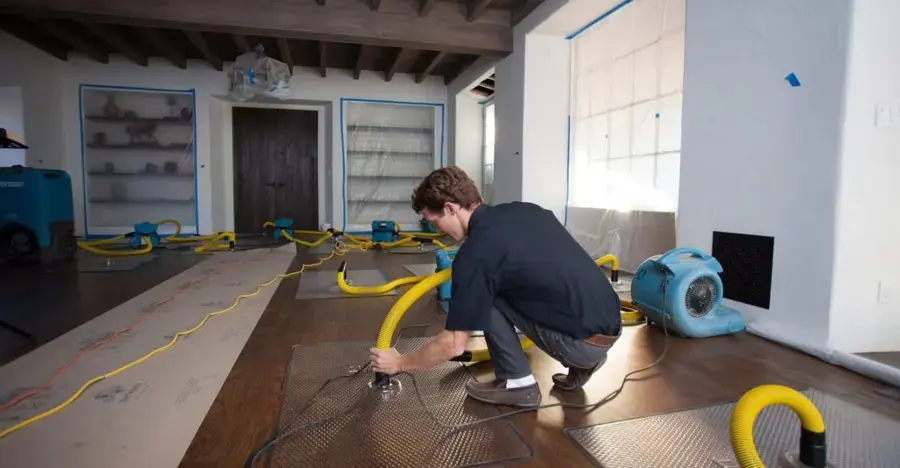
Standing water keeps wicking into drywall, baseboards and the slab edge until it leaves the building. The extraction crew pulls it out with truck-mounted units, then the drying team takes over.
(888) 450-9281Water still spreading? Call La Mesa now.- 24/7 dispatch
- IICRC S500 drying standard
- Truck-mounted extraction
First steps
What to do first when water is standing in a La Mesa home
- Shut off the water at the main valve or the fixture stop.
- Turn off breakers for any wet room if the panel sits in a dry spot.
- Keep people and pets off wet floors near outlets and cords.
- Photograph every wet room before anything is moved.
- Lift rugs, cushions and boxes off the floor, then call.
The trade facts that apply
- Truck-mounted units pull far more water per pass than a shop vacuum and send it out of the building.
- Weighted extraction tools squeeze water out of carpet pad so the pad often dries in place on a Category 1 loss.
- Moisture mapping before any equipment goes down marks the true edge of the wet area.
- Category 3 water changes the plan: porous materials it touched get removed, not dried.
Call before the water reaches the subfloor: (888) 450-9281
How the work is handled
How water extraction is handled in La Mesa, CA
- 1
Map the moisture
The tech who does the walkthrough uses a pinless meter and thermal imaging to mark where water traveled under flooring and into walls.
- 2
Extract the standing water
The extraction crew runs truck-mounted units and weighted tools until the carpet, pad and hard floors stop giving up water.
- 3
Set the drying plan
The drying team sizes air movers and LGR dehumidifiers to each room's evaporation load.
- 4
Read daily, then verify
Readings go into a drying log every day until wet materials sit within a few points of a dry reference.
Typical cost
What does water extraction cost in La Mesa, CA?
In La Mesa, CA, water extraction usually runs $300 to $1,500 for the pump-out itself, and $1,500 to $5,000 or more once structural drying is added. The drivers are the water category, square footage, material class and how fast extraction started.
Single room pump-out
$300 to $900
- Category 1 water
- Carpet or hard floor
- Caught early
Multi-room extraction
$900 to $2,500
- Two to four rooms
- Pad lifted or replaced
- Air movers set
Extraction plus drying
$2,500 to $6,000+
- Whole level or slab edges
- Wall cavities opened
- Several days of equipment
These are typical ranges, not a quote. Try the water damage cost calculator for a planning number.
Why extraction speed decides the size of the job
Water on a La Mesa floor does not sit still. It runs under baseboards, soaks the bottom of drywall and wicks into the slab edge on the single-story ranch homes that fill Mount Nebo, Windsor Hills and Lake Murray. Every hour it stays, more material moves from a dry-in-place job to a tear-out job.
The extraction crew treats standing water as the first problem because air movers cannot dry a floor that still holds water. Pulling it out with truck-mounted suction shortens the drying phase more than any other single step.
Carpet, pad and hard floors
On a clean-water loss the crew often saves carpet by using weighted extraction tools that press water out of the pad. Laminate and engineered flooring trap water underneath, so the tech usually checks under the planks with a meter before deciding what stays. Tile over a slab can hide water in the grout lines and along the walls.
- Category 1 (clean supply water): most carpet and pad can be extracted and dried.
- Category 2 (washing machine, dishwasher): pad usually comes out, carpet may be cleaned and dried.
- Category 3 (sewage, outside flood water): porous flooring gets removed and bagged.
What the claim file needs from day one
Adjusters look for the moisture map, timestamped photos taken before anything is removed, and daily readings that show the drying progressed. The restoration team records all three from the first visit. The EPA home moisture page explains why fast drying matters, and Ready.gov covers electrical safety around standing water. See also structural drying for the next phase.
Service area
Water Extraction across La Mesa and nearby
The La Mesa restoration crew handles water extraction in every La Mesa neighborhood and the hills around it.
The drying team covers every La Mesa neighborhood and the hills around it, from La Mesa Village and Grossmont to Mount Helix and Lake Murray.
Coverage includes La Mesa Village, Grossmont, Mount Nebo, Windsor Hills, Mount Helix, Casa de Oro, Fletcher Hills, Spring Valley, Rolando, San Diego College Area, Del Cerro and the rest of the area, with ZIP codes 91941, 91942, 91943, 91944.
See every area and ZIP coveredRelated
Related water damage services in La Mesa
Questions
Water Extraction questions in La Mesa, CA
Can a wet carpet be saved after water extraction?
Often, yes, when the water is clean and extraction starts quickly. The extraction crew presses water out of the pad with weighted tools, then air movers and dehumidifiers finish the job. Carpet soaked by Category 2 or 3 water is a different story: the pad usually comes out and Category 3 carpet is removed.
How much water can a truck-mounted unit remove?
A truck-mounted extractor moves far more water per pass than a rental wet vacuum, and it sends the water out to the truck instead of into a small tank. That is why the crew can clear several rooms in one visit.
Why do the crews still bring air movers after extracting?
Extraction removes the standing water, but drywall, framing, pad and the slab still hold moisture. Air movers and LGR dehumidifiers pull that moisture out until readings match a dry reference material in the same home.
Is water extraction covered by homeowners insurance?
Sudden and accidental water, such as a burst supply line, is often covered under a homeowners policy after the deductible. Rising surface water from a storm usually falls under flood coverage instead. Coverage depends on your policy, so it is worth checking with your own insurer.
Should I use a shop vacuum before help gets there?
Only on small amounts of clean water and only if the area has no electrical risk. Never vacuum sewage or storm water. Photograph the damage first so the claim file shows the original condition.
Do the crews handle water on concrete slab floors?
Yes. Most La Mesa homes sit on slabs, so the extraction crew clears the surface, then the drying team checks the slab edge and the bottom plate of each wall, where water tends to stay longest.
24/7 emergency water damage restoration
Water Extraction in La Mesa? Get the drying started today.
The extraction crew pulls the water, the drying team sets equipment to the room, and daily readings go into the claim file.